
 Software
 CapCut
 Camera
 Charger
 Gadgets
 Earbuds
 Mobile Phone
 Nokia
 Samsung

 Home Decor
 Home Appliances

 Smart Watch

Nokia 2660 Flip Review (2026): The Flip That Outlived 3G

Nokia 2660 Flip Review: The Flip Phone That Outlived Britain’s 3G Switch-Off
The UK’s 3G networks are gone, and a generation of beloved basic phones went quiet with them. This is the simple flip that didn’t — big buttons, an emergency key that works with the phone closed, and 4G inside. Here is the whole truth about it, including the camera.
Big tactile buttons, a bright 2.8-inch screen, open to answer and close to hang up. No apps, no accounts, no updates demanding attention. These are the four facts that decide this phone.
No photo of this phone exists that we’re licensed to publish — so no stock picture and no drawing. Until we can shoot one ourselves, the facts above are the portrait.
- It survives the switch-off: UK 3G is finished on all four networks, and 2G follows from 2029. This flip runs on 4G with VoLTE, so it keeps working where older basic phones have gone quiet.
- The emergency key is the headline: one press-and-hold reaches up to five saved contacts in turn — but only after someone spends a few minutes saving them. Out of the box, the list is empty.
- No WhatsApp — and there never was. This phone’s S30+ software never had it, so nothing was taken away. Some roundups still claim otherwise; they’re wrong, and we’ll show you where.
- Battery truth: days between charges in light use. HMD’s own talk-time figures vary by region — up to 6 hours on 4G in the European datasheet — and we’ll flag the small print rather than hide it.
- The camera is the weak spot: a 0.3 MP VGA unit from another era. Buy this phone for calls, texts and calm — not for photographs.
Somewhere in Britain right now there is a drawer with a flip phone in it that no longer works. Not broken — orphaned. The 3G network it depended on has been switched off by every UK operator, and the phone simply has nothing left to talk to. If that drawer belongs to your mum, you already know the rest of the story: the smartphone you replaced it with is too much, and she wants her flip back.
The Nokia 2660 Flip is the flip she can have. It looks and behaves like the phones in that drawer — big buttons, a bright screen, open to answer, close to hang up — but inside it speaks 4G, the language Britain’s networks actually speak now. On its back sits a dedicated emergency button that, once your family sets it up, calls up to five of you in turn until somebody answers.
We sell Nokia feature phones every day in our Dhaka shop, and the buyers of phones like this ask the most practical questions in the business: Will it still work next year? Will Dad hear it ring? If he falls, does it do anything? For the UK version of those questions, the answers are below — the way we’d answer them at the counter.
Buy it if: you’re replacing a basic phone that died with the 3G switch-off, choosing for a parent, or cutting your own screen time down to calls and texts.
Skip it if: the family lives on WhatsApp, anyone expects real photos from the camera, or the buyer needs apps, maps or video calls.
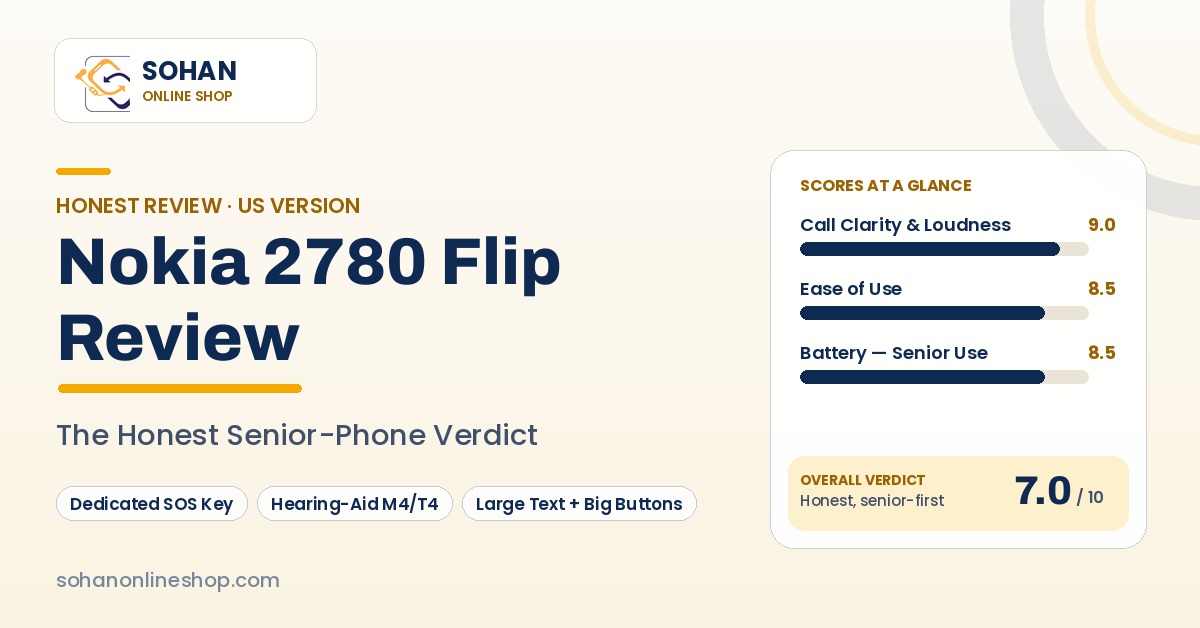
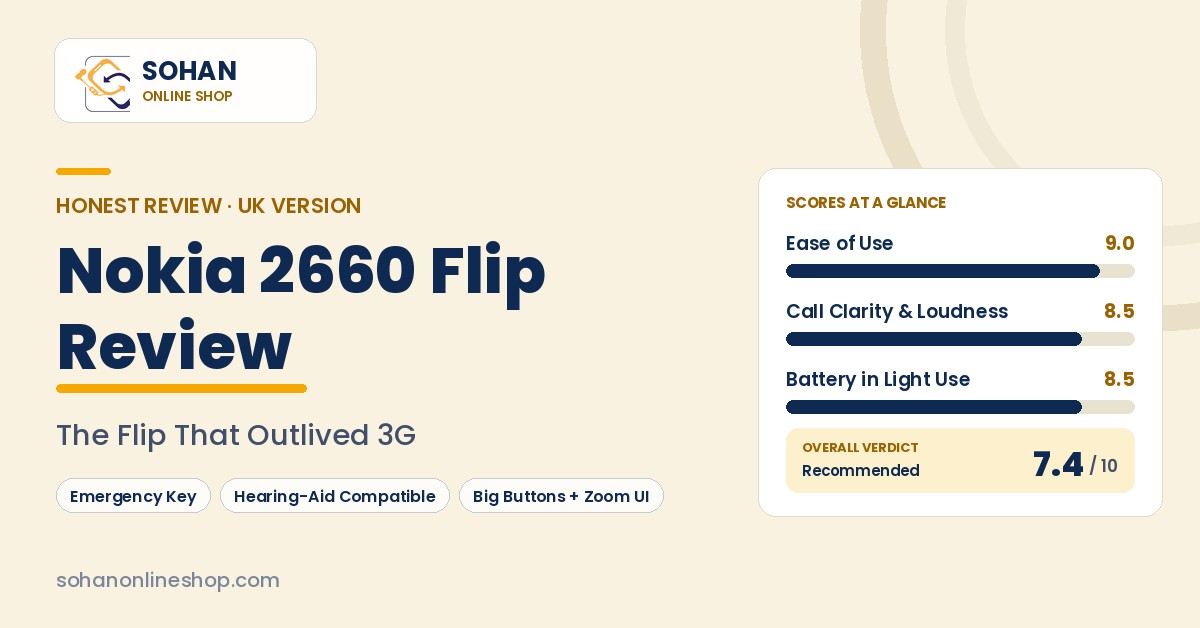
Our editorial scores — our own assessment, not Amazon’s ratings.
Check the Nokia 2660 Flip on Amazon UK →01The problem this phone actually solves
Nobody buys this phone on a whim. It is bought at a specific moment — usually when an old, trusted handset stops working, or a smartphone finally becomes too much. Worth naming honestly:
| Your problem | How this phone answers it | Where it can’t |
|---|---|---|
| Mum’s old flip died in the 3G switch-off | Same flip shape and habits, but 4G VoLTE inside — ready for today’s UK networks | The menu is S30+, not the exact software her old Nokia ran; give her an afternoon to settle in |
| Dad can’t hear the ring or the caller | Loud call sound with adjustable volume, hearing-aid compatibility, and a hands-free speaker | HMD publishes no M/T rating for it — its American cousin’s M4/T4 is a stronger paper promise (see §14) |
| You worry about a fall at home | A real emergency key on the back: press and hold, and it calls up to five family contacts in turn, open or closed | Not a medical alert: no fall detection, no automatic 999 call, and the contact list starts empty |
| The family chat keeps everyone close | Calls and texts still reach everyone, and the number stays the same | WhatsApp has never existed on this phone — if the group chat is the connection, this is the wrong phone |
| Charging is one chore too many | Days between charges; removable battery; an optional charging cradle gives it a fixed home | The cradle is sold separately, and the Nokia version charges by micro-USB, not USB-C |
02The emergency key: small button, serious job
Plenty of phones bury “emergency call” three menus deep, where a frightened person will never find it. The 2660 Flip puts a physical emergency button on the back of the handset, where a thumb finds it by touch — and it works whether the flip is open or closed, which matters for a phone that might be sitting on a hallway table when it’s needed. From HMD’s user guide, exactly what it does:
- Press and hold the button, and the phone starts calling your emergency contacts — the list of up to five people you saved in advance.
- It works through the list one contact at a time, cycling until somebody answers — no app, no subscription, no monitoring company in the middle.
- Because it’s a real button on the back of the phone, it can be pressed with the flip closed — no opening, unlocking or screen-watching required.
03Set it up together — ten minutes
Do this with your parent, at their kitchen table, the day the phone arrives. It turns a gadget in a box into something that quietly protects them.
Fit the battery and the SIM. The battery is removable and packed in the box — click it in, add a nano-SIM (this model takes two, if a second number is useful), and give it a first full charge before anything else.
Add the emergency contacts. Menu → Settings → Emergency calls — save up to five people in calling order: you, a sibling, a neighbour with a key. This one step is the difference between an emergency button and a decoration.
Tell the five people they’re on the list. An emergency call that arrives as a surprise gets treated like a nuisance call. A two-minute warning to each person makes the chain work when it matters.
Test it, together. With everyone warned, press and hold the button and watch the chain run. Let your parent hear how it behaves — a system they’ve seen work is one they’ll trust at 3 a.m.
Make it loud and clear. Set the ringtone and call volume to full, and check the earpiece volume on a real test call. The loud sound settings are a feature only if somebody turns them up.
Give the phone a home. Charger in the same place every night — or the optional charging cradle by the bed or the front door. Days of battery only protect someone if the phone is charged and within reach.
Ten minutes, once. After that, the phone asks for almost nothing: no updates, no passwords, no accounts.
04Unboxing: plain and simple
Inside the box: the handset, a micro-USB charger, the removable battery, and the user guide. That’s the whole list, and there’s a quiet advantage in it: because the battery comes separate and clicks in by hand, a tired battery in a few years is a cheap swap, not a repair bill. Not included: a SIM card, a memory card, headphones — or the charging cradle, which is an optional extra sold separately.
05Design and living with it
This is a light phone — 123 grams — and a compact one: 108 × 55 × 18.9 mm folded, small enough to disappear into a shirt pocket. The clamshell shape earns its keep every day: closed, it protects the screen and the keypad from scratches and pocket-dialling; open, it becomes a long handset that sits properly against the ear, the way phones did for thirty years.
The buttons are genuinely big and tactile — the single most praised thing about this phone in buyer feedback — and owners describe a hinge that feels reassuringly solid, with that old mechanical snap on closing. The honest counterweight: the shell is plain plastic and feels it, some owners call it cheap-feeling, and HMD gives the Nokia version no water-resistance rating, so it’s a phone to keep out of the rain rather than one to shrug it off. The little 1.77-inch cover screen shows the time and who’s calling before you open it — quietly preventing a lot of scam-call anxiety.
06Full specifications (UK/EU version)
| Software | S30+ (Series 30+) — no app store, no accounts |
| Processor / memory | Unisoc T107 (1.0 GHz) · 48 MB RAM · 128 MB storage · microSD up to 32 GB |
| Main display | 2.8″ QVGA TFT (240 × 320), non-touch |
| Cover display | 1.77″ QQVGA (160 × 128) — time and caller ID |
| Camera | 0.3 MP (VGA) rear with LED flash · no front camera · flash doubles as a torch |
| Battery | 1,450 mAh, removable · micro-USB charging · compatible with a charging cradle (sold separately) |
| Talk time (manufacturer) | Up to 6 hrs on 4G · up to 20 hrs on 2G (HMD European datasheet — see the honesty note below) |
| Connectivity | 4G LTE (EU bands 1/3/5/7/8/20) · VoLTE · Bluetooth 4.2 · no Wi-Fi · no GPS |
| Extras | Dedicated emergency key · hearing-aid compatible · wireless FM radio · MP3 player · 3.5 mm headphone jack |
| SIM | Dual nano-SIM (dual standby) |
| Dimensions | 108 × 55 × 18.9 mm (folded) |
| Weight | 123 g |
| Colours | Black, blue, red · Pop Pink and Lush Green added in 2023 |
| Launched | July 2022 |
07Will it still work on UK networks? The switch-off, explained
This is the section that decides the purchase for most British buyers, so here is the plain version. The UK’s 3G networks are finished — Ofcom confirms all four operators have completed their 3G switch-offs. Phones that relied on 3G for calls have already lost their footing. 2G is next, on a slower timetable — and this phone doesn’t depend on either, because it makes its calls over 4G with VoLTE.
| Network | 3G status | 2G switch-off announced |
|---|---|---|
| EE | Switched off | Begins May 2029 |
| Vodafone | Switched off | During 2030 |
| Three | Switched off | Three has no 2G network |
| O2 | Switched off | Begins summer 2029 |
On smaller brands — giffgaff, Tesco Mobile, Smarty, Lebara and the rest — your SIM rides on one of the four networks above, and the same dates apply. Three practical things nobody mentions:
1. Buy the UK/EU version. It carries LTE bands 1, 3, 5, 7, 8 and 20 — including band 20, the 800 MHz band British networks lean on for rural and indoor coverage. Grey imports built for other regions can miss band 20 and feel oddly deaf outside town.
2. VoLTE is the feature that matters. With 3G gone, a 4G phone that can’t call over 4G falls back to 2G. This one supports VoLTE, so calls stay on the modern network.
3. It takes two nano-SIMs. Handy if your parent keeps a second number, or if you want a backup network in a weak-signal area.
08Battery: the honest version of “up to 20 hours”
One number follows this phone around — “up to 20 hours of talk time” — and it needs its context restored: that is HMD’s 2G figure. On 4G, the European datasheet quotes up to 6 hours of talk. Both are lab numbers. Neither describes your parent’s life.
The pattern from buyer feedback is consistent: a few calls and texts a day means several days between charges — around four days in moderate use, stretching past ten for light users. There is no Wi-Fi, no GPS and no app store quietly sipping power in the background, which is precisely why a modest 1,450 mAh battery goes so far here. And when the battery eventually tires, it unclips by hand and a fresh one clicks in — no repair shop, no glued-shut surgery.
09Software: S30+ — the phone that never had WhatsApp to lose
The 2660 Flip runs S30+, the simplest software Nokia phones have used for years. There is no app store, no account to create, no updates to install, no notifications competing for attention. Calls, texts, contacts, a camera, an alarm, a calendar, a calculator, FM radio, an MP3 player, a torch — and yes, Snake is pre-installed. The menus respond instantly and look the same every single day, which is exactly what the buyer of this phone is paying for.
Now the section we wish we didn’t have to write, because it will decide this purchase for many families:
What else to calibrate:
Know before you buy
- No maps, no GPS. This phone cannot guide anyone home. It makes calls and sends texts; navigation is a smartphone’s job.
- There is technically a basic browser — and it is so slow and stripped-down that you should treat this phone as offline. That’s rather the point of it.
- No video calling of any kind. No front camera, no apps — if seeing the grandchildren’s faces is the goal, stop here.
- Nothing to break later. The flip side of a frozen feature set: no service will be “discontinued” on this phone next year, because there are no services. What works on day one works on day one thousand.
10Camera and sound: one is a rumour, one is real
Sound first, because it’s the senior story. HMD built this phone around being heard: loud call sound with adjustable volume settings, a proper hands-free speaker, and hearing-aid compatibility, so calls stay clear for wearers. One honest asterisk we’ll keep repeating: HMD doesn’t publish an M/T rating for the 2660 the way it does for the American 2780 (M4/T4) — “hearing-aid compatible” is the claim, and owner feedback on loudness is broadly positive, but if a published rating matters to you, §14 shows the difference plainly. The FM radio plays wirelessly through the speaker or wired through headphones, and the MP3 player plus a microSD card turns it into a simple pocket radio-and-music box.
The camera is a 0.3 MP VGA unit — the resolution phones had two decades ago — with an LED flash. Let us be as plain as the template of this review allows: it takes record shots, not photographs. A snap of a letter, a bus timetable, a suspicious van’s number plate: fine. Grandchildren, gardens, holidays: you will be disappointed, and so will they. Its flash has one redeeming second job — it doubles as a torch, which in a dark hallway is worth more than the camera ever will be.
11What real buyers keep saying
We read the recurring themes across UK retailer buyer feedback for this phone so you don’t have to. In our own words, the pattern is remarkably consistent:
Owners love
- The large buttons and straightforward operation — the praise appears in review after review
- Battery that lasts days the way they actually use it
- The flip itself: open to answer, close to hang up, with that old mechanical snap
- A hinge that feels solid to most owners
- How completely it removes social media from the day
Owners grumble about
- The camera — weak even by basic-phone standards
- Plastic that feels cheap to some, however sturdy others find it
- A side volume button that can nudge itself in a pocket or bag
- Call-quality reports that vary — mostly clear, occasionally not
- The absence of Wi-Fi, for the few who expected it
- Rubberised buttons one owner doubts will age well
12Who should buy it — persona by persona
This phone’s home crowd. Mum’s old flip went quiet when 3G did; this is the same shape, the same habits, on a network that isn’t going anywhere — if you do the ten-minute setup and your family runs on calls and texts.
If you want your phone to be a phone again — big buttons, loud and clear, charged once or twice a week, nothing beeping for attention — this is honestly one of the best answers still on sale in Britain. The menus are simpler than the app-phones, and simpler than its KaiOS cousins too.
Hearing-aid compatibility, loud adjustable call sound and a proper speaker make a strong practical package — with one caveat: HMD publishes no M/T rating here, so if a certified rating is a must, compare §14 before deciding.
Younger buyers pick this up as a detox phone and love it for the same reasons seniors do — no feeds, no group-chat roar, a battery that outlasts the working week. Pop Pink and Lush Green exist precisely for you.
Stop here. No front camera, no WhatsApp, no video calling of any kind. This phone will not do the thing you’re actually buying it for.
13Dealbreakers — walk away if any of these are you
- The family talks on WhatsApp — it has never existed on this phone
- Your parent needs video calls with grandchildren, or turn-by-turn directions
- Anyone expects real photographs — the camera is 0.3 MP VGA
- You need Wi-Fi, Bluetooth is not enough, or you rely on mobile internet
- Nobody will do the ten-minute setup — the emergency key stays a decoration
- You want USB-C and splash resistance in this exact phone — that combination is the newer HMD-branded refresh, not the Nokia original (§14)
14Nokia 2660 Flip vs Nokia 2780 Flip: the Atlantic divide
If you’ve been reading American reviews, you’ve met this phone’s cousin. The Nokia 2780 Flip is the US model — sold for American carriers, never officially sold in the UK. The 2660 Flip is the one made for Britain and Europe. They share a silhouette and a battery; almost everything inside differs:
| Nokia 2660 Flip (UK/EU) | Nokia 2780 Flip (US) | |
|---|---|---|
| Software | S30+ — no apps at all | KaiOS 3.1 — app store, basic Google services |
| Camera | 0.3 MP (VGA) | 5 MP |
| Memory | 48 MB RAM · 128 MB storage | 512 MB RAM · 4 GB storage |
| Battery | 1,450 mAh removable | 1,450 mAh removable |
| Charging | Micro-USB | USB-C |
| SIM | Dual nano-SIM | Single nano-SIM |
| Wi-Fi / GPS | Neither | Wi-Fi b/g/n · GPS |
| Hearing aids | Hearing-aid compatible (no published M/T rating) | M4/T4 published — top tier |
| Emergency help | Emergency key on the back — up to 5 contacts, works open or closed | Dedicated SOS key — ICE call chain plus SOS text |
| Networks | EU LTE bands incl. 20 — built for UK/EU networks | US LTE bands incl. 71 — built for US carriers |
| Weight | 123 g | 131 g |
| Colours | Black, blue, red, Pop Pink, Lush Green | Blue, red, black |
The honest summary: the 2780 is the more capable phone — better camera, an app platform, a published hearing-aid rating. The 2660 is the simpler one — quicker menus, dual SIM, nothing to discontinue — and, decisively, it is the one that works properly on British networks and is actually sold here. Our full 2780 Flip review covers the American cousin in the same honest detail.
One family connection worth knowing: in Europe, the HMD Barbie Phone is built on this very 2660 platform — same bones, pink universe. Our Barbie review looks at that version from the detox angle.
15What most reviews won’t tell you
- The “20-hour battery” headline is a 2G number. On the 4G network your parent will actually use, HMD’s own datasheet says up to 6 hours of talk. Still days of real life — but know which number is which.
- Some roundups claim this phone runs KaiOS with WhatsApp. It doesn’t and never did — that error was copied from articles about the 2780. Any buying decision built on it ends in a return.
- The emergency key arrives with an empty list. No setup, no call chain — the phone’s most reassuring feature depends on five minutes of homework nobody advertises.
- Two different phones share this name. Nokia-branded original (micro-USB) vs 2025 HMD-branded refresh (USB-C, IP54). Listings mix them up; the charging port tells you the truth.
- Band 20 is the quiet deal-maker in Britain. A cheap import missing it will feel fine in the city and half-deaf in the countryside.
16Decide in 10 seconds
an old basic phone died with 3G, or your parent needs calls and texts to just work — loudly, simply, for days — and someone will set up the emergency key with them.
WhatsApp, video calls, real photos or apps are part of how your family connects.
the listing is a grey import — confirm it’s the UK/EU version with band 20, and whether it’s the Nokia original or the HMD refresh.
17What’s in the box
Not included: a SIM card, a memory card, headphones — or the charging cradle, which is an optional extra.
18Frequently asked questions
Does the Nokia 2660 Flip have WhatsApp?
No — and it never has. The 2660 Flip runs S30+ software, which has never supported WhatsApp; there is no app store and no way to add it. Some online roundups wrongly describe this phone as running KaiOS with WhatsApp — that describes a different model (the US Nokia 2780 Flip), and even there, WhatsApp ended in February 2025. If your family lives on WhatsApp, this is not the phone for them.
Will the Nokia 2660 Flip still work in the UK after the 3G switch-off?
Yes. All four UK networks — EE, Vodafone, Three and O2 — have completed their 3G switch-offs, and this phone doesn’t need 3G: it makes calls over 4G with VoLTE. It also doesn’t depend on 2G, whose switch-offs begin in 2029. Buy the UK/EU version, whose LTE bands (1, 3, 5, 7, 8, 20) include band 20, widely used for rural and indoor coverage in Britain.
How does the emergency button work — and what are its limits?
First, someone adds up to five emergency contacts under Menu → Settings → Emergency calls. After that, pressing and holding the dedicated button on the back of the phone — which works whether the flip is open or closed — makes the phone call those contacts one by one, cycling until somebody answers. Its limits: it calls your family, not 999; there is no fall detection; and it does nothing until the contacts are saved.
Is the Nokia 2660 Flip good for someone with hearing aids?
It’s a strong practical choice: HMD rates it hearing-aid compatible, with loud call sound and adjustable volume settings, and owners broadly praise its loudness. One honest caveat: HMD doesn’t publish an M/T rating for this model the way it does for the US Nokia 2780 Flip (M4/T4, the top tier). If a published rating is essential, that’s the clearest difference between the two phones.
How long does the battery really last?
Days, the way most owners use it: UK retailer review summaries put it at roughly four days of moderate use and ten days or more of light use. HMD’s European datasheet quotes up to 6 hours of talk time on 4G and up to 20 hours on 2G — the “20 hours” in headlines is the 2G figure. The 1,450 mAh battery is removable, so when it tires after a few years, a fresh one clicks in by hand.
Nokia 2660 Flip or the newer HMD 2660 Flip — what’s the difference?
They’re siblings, not the same phone. The Nokia-branded original (2022) charges by micro-USB, has Bluetooth 4.2, no water-resistance rating, weighs 123 g, and comes in black, blue, red, Pop Pink and Lush Green. The HMD-branded refresh (2025) switches to USB-C, adds Bluetooth 5.0 and an IP54 splash-resistance rating, weighs 136.4 g, and comes in Twilight Violet, Raspberry Red and Cosy Black. Screens, battery size and the emergency-key idea are shared. Check the badge and the charging port on any listing before buying.
19The bottom line
The Nokia 2660 Flip is not the most capable phone you can buy your parent. It’s something rarer in Britain in 2026: a flip phone that still works. Loud, clear calls for days on a charge, genuine respect for ageing hands and ears, an emergency key that — once your family does ten minutes of homework — is a small, real safety net, and 4G inside so the network switch-offs can’t orphan it.
It is also a phone with no WhatsApp and never any, a VGA camera from another century, and a micro-USB port in a USB-C world. Both paragraphs are the review.
If your family’s connection runs on calls and texts, this unassuming flip is a real answer. Check it on Amazon UK → — eyes open, setup scheduled, no regrets.
How we review: Sohan Online Shop sells Nokia and feature phones in Bangladesh every day. This review is built from HMD’s official specifications and user guide, Ofcom’s published switch-off information, cross-checked specification databases, and the recurring patterns in UK retailer buyer feedback — read and rewritten in our own words. We have not yet imported a UK unit to our Dhaka shop for hands-on testing; when we do, this page will be updated and the change noted here. We correct our articles when facts change — that’s the deal.